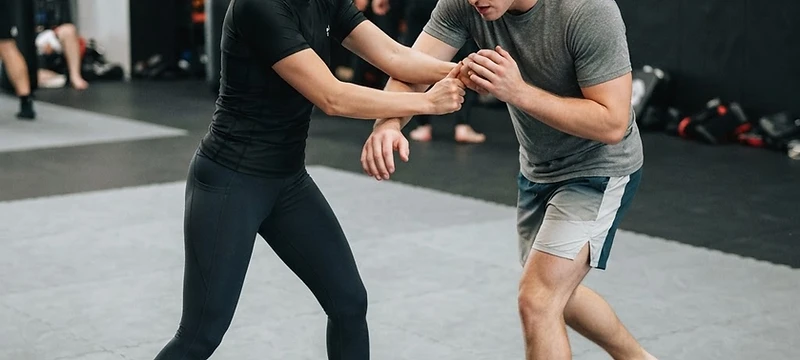
A practical guide to self-defence for residents of Billingshurst and West Sussex — how Brazilian Jiu-Jitsu and kickboxing develop the skills, awareness, and confidence to stay safe in real-world situations.
Quick answer
Effective self-defence combines awareness, avoidance, de-escalation and physical capability. Brazilian Jiu-Jitsu covers the clinch and ground, while kickboxing covers striking range — together they form a complete, tested system.
Key takeaways
- Most real confrontations end in a clinch or on the ground, which is where BJJ is strongest.
- Kickboxing develops the distance management and striking skills needed before a clinch.
- Under stress, people fall to their level of training — live practice is what builds composure.
- BJJ allows controlled responses, which matters for both safety and UK law on reasonable force.
- Self-defence is about getting home safely, not winning a fight.
Introduction: Self-Defence Is a Life Skill
Self-defence is something many people think about but few ever actually prepare for. We lock our doors, we install alarms, we're careful where we walk at night — but when it comes to the physical skills and mental preparation that could one day keep us safe, most people do nothing. The hope is that we'll never need them. The reality is that having them changes everything — not just in the unlikely event of an attack, but in how confidently and calmly we move through the world.
Here in Billingshurst and across West Sussex, we're fortunate to live in a relatively safe area. But "relatively safe" is not the same as "safe." Incidents happen everywhere, and the confidence that comes from knowing you can handle yourself is valuable regardless of where you live or work. At Billingshurst Mixed Martial Arts Nova Forca, we've helped hundreds of people across the local area develop genuine, practical self-defence skills through Brazilian Jiu-Jitsu and kickboxing. In this guide, we'll explain what real self-defence looks like, how our disciplines develop it, and how you can start building your own capability today.
What Real Self-Defence Actually Means
Self-defence is not what you see in films. It's not a single decisive strike that ends a confrontation, and it's not a collection of flashy techniques that work on a compliant partner. Real self-defence is a combination of awareness, avoidance, de-escalation, physical capability, and the mental composure to apply all of these under extreme stress.
Awareness
The foundation of self-defence is awareness. Most attacks are preceded by warning signs — someone behaving oddly, a situation that feels wrong, an environment that's unsafe. People who train in martial arts develop a heightened sense of situational awareness. They're more attuned to their environment, more likely to notice potential threats early, and more likely to avoid dangerous situations entirely. This is the most effective form of self-defence: never being in the situation in the first place.
Avoidance
The best fight is the one you're not in. If you can avoid a confrontation — by crossing the street, by leaving a venue, by de-escalating — that is always the best outcome. Martial arts training doesn't make you eager to fight; it makes you confident enough to walk away. Ego is the enemy of good self-defence.
De-Escalation
Many confrontations can be defused with the right words, the right body language, and the right attitude. Confident, calm people are less likely to be attacked. Martial arts training develops this calm confidence. You learn to manage your adrenaline, to think clearly under pressure, and to project an aura that discourages aggression.
Physical Capability
If avoidance and de-escalation fail, you need physical capability. This means the ability to strike effectively, to defend against strikes, to control an attacker, to escape from dangerous positions, and to apply submissions if necessary. This is where Brazilian Jiu-Jitsu and kickboxing come in — together, they provide a comprehensive, tested self-defence skill set.
Composure Under Stress
All of the above is useless if you freeze when it matters. The most valuable thing martial arts training develops is the ability to function under pressure. Through regular sparring and live training, you learn to manage fear and adrenaline, to think clearly when someone is trying to hit or control you, and to apply your techniques against a resisting opponent. This composure is the thread that ties everything together.
Why Brazilian Jiu-Jitsu Is Essential for Self-Defence
Brazilian Jiu-Jitsu is arguably the single most effective martial art for real-world self-defence, and here's why.
Most Real Fights End Up on the Ground
The statistics are clear: the majority of real-world altercations end up in a clinch and on the ground. This is true whether the confrontation involves one attacker or several, whether it's a mugging or a brawl. If you don't know what to do on the ground, you're at the mercy of anyone who ends up on top of you. BJJ teaches you exactly what to do — how to escape from underneath a larger attacker, how to control them, and how to submit them if necessary.
It Works Against Larger, Stronger Attackers
This is the core principle of BJJ. Through leverage and technique, a smaller, weaker person can defeat a larger, stronger one. This is not theory — it's tested every day in every BJJ gym in the world. For self-defence, where you may well be facing someone bigger and stronger than you, this is essential.
It Allows Controlled, Scalable Responses
Not every self-defence situation requires you to cause serious harm. Sometimes the appropriate response is to control someone until help arrives, or to escape as soon as you can. BJJ allows this. You can hold someone in a dominant position, apply a submission that ends the threat without lasting damage, or simply create the space to get away. This controlled, scalable response is one of the reasons BJJ is favoured by law enforcement and security personnel.
It Teaches You to Stay Calm in Bad Positions
One of the most valuable things BJJ develops is the ability to stay calm when you're in a bad position. Beginners panic when they're underneath someone; experienced grapplers are calm, think clearly, and work their escape. This composure, developed through thousands of repetitions in training, is exactly what you need in a real self-defence situation.
Why Kickboxing Complements BJJ for Self-Defence
While BJJ excels at the clinch and ground phases of a confrontation, kickboxing is essential for the standing, striking phase. Together, they provide a complete self-defence system.
Distance Management
The most important skill in standing self-defence is distance management — knowing how far away you need to be to avoid being hit, and how to close or create distance as needed. Kickboxing develops this skill through years of sparring. You learn to read an attacker's distance, to use footwork to stay safe, and to close the distance to strike or clinch when the opportunity arises.
Effective Striking
If you need to strike — to create an opportunity to escape, to discourage an attacker, or to defend yourself — you need to be able to do it effectively. A properly thrown punch or kick is far more powerful and far less likely to injure you than an untrained one. Kickboxing teaches you to strike with power, accuracy, and proper technique.
Defensive Skills
Knowing how to defend against strikes is just as important as knowing how to throw them. Kickboxing teaches you to block, slip, parry, and move your head, so you're far less likely to be hit cleanly if someone tries to strike you.
The Ability to Fight at Range
BJJ is most effective at close range and on the ground. If an attacker is at striking distance, you need the skills to deal with that range before you can close to clinch or escape. Kickboxing gives you those skills, making your overall self-defence game far more complete.
Common Self-Defence Myths
Myth 1: "I'll Just Hit Them Once and Run"
This is the most common self-defence myth. In reality, a single strike rarely ends a confrontation, especially if you've never actually hit anyone before. Adrenaline, movement, and the chaos of a real situation make clean strikes difficult. Training gives you the ability to strike effectively and the composure to do so under pressure.
Myth 2: "Size and Strength Don't Matter"
This is an overstatement. Technique can overcome size and strength, but it's not magic. A larger, stronger attacker is a serious threat, and you need genuine, tested skills to deal with one. This is exactly what BJJ and kickboxing develop.
Myth 3: "I'll Rise to the Occasion"
Under extreme stress, people don't rise to the occasion — they fall to their level of training. If you've never trained under pressure, you'll likely freeze. Regular sparring in a controlled environment is what builds the ability to function when it matters.
Myth 4: "Self-Defence Is About Fighting"
Self-defence is about survival. The goal is to get home safe, not to win. The best self-defence practitioners are the ones who avoid fights, de-escalate confrontations, and only use physical skills when there's no other option.
Myth 5: "Watching Videos Is Enough"
You cannot learn self-defence from videos. You need to practise against real, resisting opponents in a controlled environment. This is the only way to develop the timing, feel, and composure that real self-defence requires.
Self-Defence for Women
Self-defence is particularly important for women, who face different and often greater risks. Brazilian Jiu-Jitsu is especially valuable for women because it's specifically designed to allow a smaller person to defeat a larger one — exactly the scenario women may face. BJJ teaches women how to escape from underneath an attacker, how to control a larger opponent, and how to apply submissions that can end a threat.
Beyond the physical skills, the confidence that comes from regular training is transformative. Women who train carry themselves differently, are more aware of their surroundings, and project a confidence that discourages potential attackers. At Billingshurst MMA, we have a growing female membership and a culture that's welcoming, respectful, and supportive.
Self-Defence for Older Adults
Self-defence isn't only for the young. Older adults can benefit enormously from martial arts training, both for the self-defence skills and for the fitness, mobility, and confidence it develops. Our training is scalable — you work at your own pace, and our coaches can modify anything to suit your body and your goals. We have members well into their 50s and 60s who train regularly and have developed genuine capability.
The Legal Context of Self-Defence in the UK
In the UK, you're legally entitled to use reasonable force to defend yourself. What counts as "reasonable" depends on the circumstances, but the key principle is that your response should be proportionate to the threat. This is one of the advantages of BJJ — it allows you to control an attacker and end a threat without necessarily causing serious harm, which is often the legally appropriate response. We discuss the legal context of self-defence as part of our training, so you understand not just how to defend yourself but how to do so within the law.
How to Start Developing Your Self-Defence Skills
The only way to develop real self-defence skills is to train. Reading about it isn't enough. Watching videos isn't enough. You need to get on the mats, practise against real opponents, and build the skills and composure that only live training can develop.
At Billingshurst Mixed Martial Arts Nova Forca, we offer a free trial class for anyone interested in developing their self-defence skills. You'll be welcomed, regardless of your experience or fitness level, and introduced to the fundamentals in a supportive, structured environment. From there, consistent training builds genuine capability over time.
There's no quick fix for self-defence. It takes time, effort, and consistent training. But the skills you develop — and the confidence that comes with them — are genuinely life-changing. You'll move through the world differently, knowing that you can handle yourself if the worst happens.
Written by
The Billingshurst MMA coaching team
Qualified, DBS-checked coaches teaching Brazilian Jiu-Jitsu and kickboxing in Billingshurst, West Sussex. More about the gym.
Ready to start training?
Book your free trial class at Billingshurst Mixed Martial Arts Nova Forca today.
Book a Free Trial